


OAK GROVE, Minn. – If you have watched Alex Honnold climb El Capitan in his documentary “Free Solo,” it might be hard to believe that rock climbing would have a low rate of injury.
It may also be hard to believe that someone with Parkinson’s disease could excel at the sport.
Dean Polsfut is proving that belief wrong.
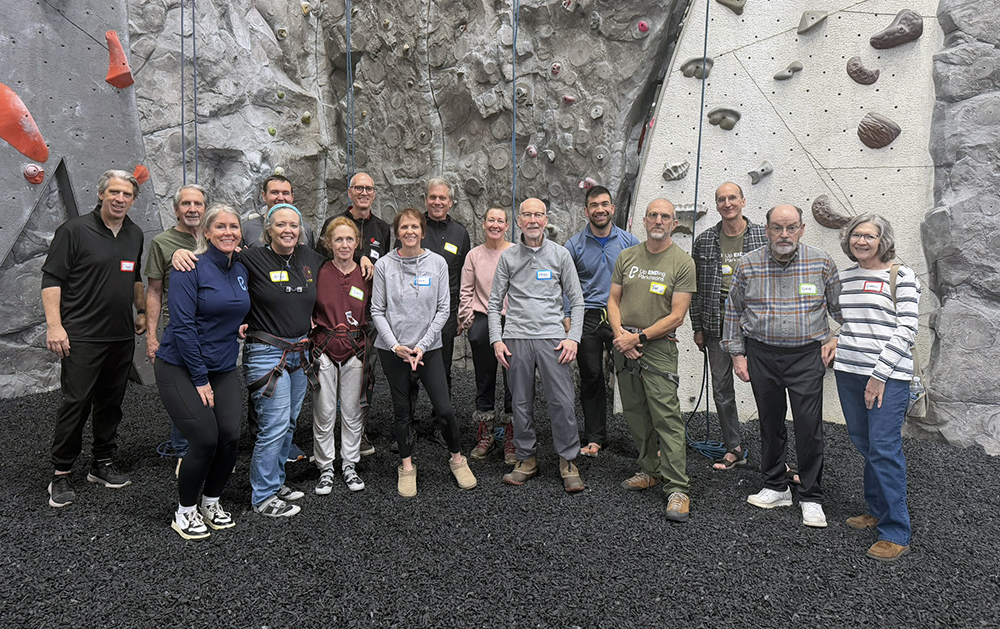
Polsfut has been rock climbing for about a year at Vertical Endeavors in Bloomington, Minnesota, and occasionally Vertical Endeavors in Duluth. He helped spearhead the Up ENDing Parkinson’s program, a non-profit program that provides a guided climbing experience for people living with Parkinson’s disease. The program adapts to each participant’s needs and abilities, offers a range of routes and challenges for all skill levels, and provides a safe, supportive environment for people at any stage of their Parkinson’s journey.
“It’s a way to find both a great physical and cognitive activity that will improve their quality of life and hopefully slow the progression of the disease,” he said.
Polsfut was diagnosed with Parkinson’s disease in the spring of 2023 and started pursuing a program to best deal with the symptoms he was experiencing, including tremors, cognitive processing, and rigidity, a stiff and constant resistance to movement in muscles. He changed his diet, began medications, and built a disciplined exercise regimen.
In fall 2024, his brother-in-law sent him a segment from “The Today Show” about a Virginia-based climbing program for people with Parkinson’s. Polsfut was intrigued and gave it a try.
He was instantly hooked.
“Rock climbing is such a comprehensive activity,” Polsfut said. “It’s high intensity, cardio, flexibility, strength, and cognitively challenging — everything I was looking for in one activity.”
He was so taken by the sport that he reached out to the president of the Up ENDing Parkinson’s program to bring the program to Minnesota. After a few Zoom calls and gentle nudges with the manager of Bloomington Vertical Endeavors, they started the first group climb in January 2025. From there, they have grown to two climbs each week, with the addition of Duluth in September 2025.
“Obviously, the best treatment for Parkinson’s is vigorous exercise, and rock climbing fits that bill in spades,” Polsfut said.
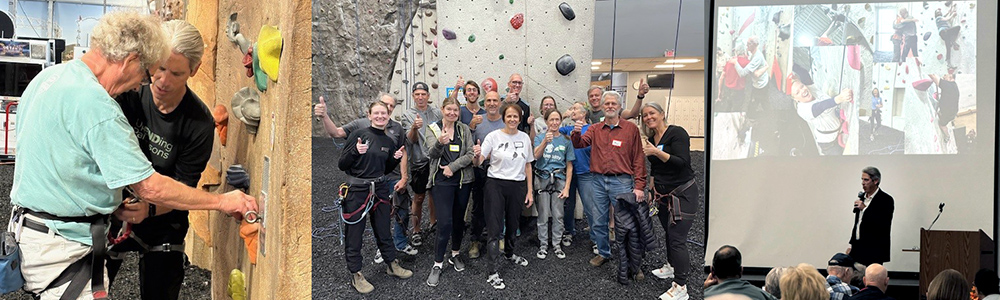
What was unexpected was the amazing community that was built among the climbers and volunteer belayers — the people who hold the rope for you when you climb, so that you don’t fall.
“People are achieving things they never thought (would be) possible again, and we are seeing such improvement in so many people,” he said.
“When you climb the wall, you aren’t just climbing the wall by yourself,” Polsfut added. “You’re also being cheered on by people who know exactly what you’re going through, as well as people who might not have the disease but are inspired to be there to cheer for other climbers. The first time a climber reaches the top of a climbing route is pretty emotional. There are cheers, high fives, hugs, and sometimes even some tears.
“It never gets old. People hate to miss a climbing session because of the amazing energy that these climbers generate.”
Polsfut grew up on a farm, with both crops and cattle, near Max and was originally drawn to Minot State because of proximity to home and its broadcasting program, which was what Polsfut wanted to pursue coming out of high school. He also joined the Mu Sigma Tau fraternity during his freshman year of college, immersing himself in the full college experience right out of the gate.
“It may not have been the best thing for my grades initially,” Polsfut said, “but I wouldn’t change a thing.”
Music, however, had always been central to his life. After playing in bands since age 14 — beginning with polka and transitioning to rock — he realized how much he enjoyed teaching private drum lessons and switched his major to music education during his sophomore year.
Some of Polsfut’s best memories from his time at MSU are with the people — the students, the staff, and administration were all incredibly supportive and committed to the students’ success. He looks back fondly on the year he served in student government as the dance governor, when he booked entertainment and worked with great people.
“The great memories exponentially outnumber the bad,” Polsfut said, “but I’ll never forget the times spent with friends, jamming in the basement of Old Main, and learning from such great instructors.”
After graduating, Polsfut moved to Minneapolis and managed a record store in the early 1990s. Then he started in an entry-level position at a mortgage investment firm to establish career opportunities and worked his way up the ladder. He made a career out of product development and even moved to the Washington, D.C., area for a couple of years in the early 2000s, before returning to Minnesota.
He now lives in Oak Grove with his wife of 25 years, Julianne, a kindergarten teacher. They have two sons, Erik, 23, and James, 21. In 2024, Polsfut retired from Wolters Kluwer, a company offering professional information, software, and services for multiple industries.
Throughout his corporate career, he maintained a work-life balance by playing in cover bands on weekends, often alongside other Minot musicians who also found their way to the city. It was a collection of personalities, perspectives, and goals that, according to Polsfut, the people in the arts community provided.
“What was great about that,” he pointed out, “is that not only did I learn how to effectively engage with so many different types of people, but many also became lifelong friends.”
The teaching component of his degree, he added, did a great job of preparing him to reach every kid in the room and to focus on the aspects that made students special rather than self-conscious.
“Those experiences were great preparation for how to ‘read a room’ in my corporate career and find ways to reach just about every person I was talking with,” he said.
Understanding and appreciating differences, Polsfut added, without casting assumptions or judgments, has resulted in building relationships based on trust and has proven effective in his career and life in general. Thanks to social media, he is still able to keep tabs on many of his old classmates and feels like they could pick up where they left off if they ran into each other.
“That’s simply the kind of environment the music program at MSU built and embraced,” he said.
Polsfut’s experience in speaking during his corporate career has segued into speaking at events about Parkinson’s and rock climbing.
“Because of how passionate I am about not only rock climbing, but inspiring people with Parkinson’s to have strength and motivation to pursue their own exercise program, I felt like there may be an opportunity for me to have a positive influence there,” Polsfut said. “The important thing is for people not to give into apathy and depression that comes with Parkinson’s and fight through it to live as productive and as long as possible.”
He initially felt apprehensive. Parkinson’s had forced him to retire due to cognitive impacts, and he feared freezing or losing his train of thought in front of a crowd. But he was reminded that those exact occurrences might also make the talk feel more authentic, which made it seem much less scary.
While Polsfut admits he is not the speaker he once was, he can appreciate the opportunity to positively influence one person to get out of their despair and find joy through health and community. He has taken multiple opportunities to talk to people in larger groups at events, community centers, and support groups and plans to continue speaking at events.
When people first start in the Up ENDing Parkinson’s program, the goal is simply to get them on the wall and feel comfortable climbing. Polsfut estimates that about one-third of the climbers are afraid of heights, but he encourages climbers to go a little further each time. And age or where individuals are at in their journey doesn’t matter, as climbers range from 45 to 87 years old.
“Some people come to climbing needing a walker to reach the wall but then can go up the wall like a mountain goat,” he said. “Most climbers say that climbing often helps them forget they have Parkinson’s.”
When the tremors subside, he added, they find confidence, their coordination improves, and everything is about moving to the next hold.”
Polsfut’s long-term goal is to make climbing accessible to everyone with Parkinson’s by expanding gym partnerships, addressing transportation barriers, assisting with costs, and increasing awareness. He hopes to open two additional climbing gyms in 2026 and continue expanding throughout Minnesota and North Dakota, with Phoenix also in development.
“One of the worst parts of Parkinson’s is the apathy and depression it brings,” he noted. “I don’t know anyone with Parkinson’s who doesn’t fight that every day, myself included.”
Climbing, for Polsfut, represents how community and exercise can serve as the best medicine.
Before Parkinson’s, he said, his life was built on stress and imbalance, and a nonexistent self-care routine. Now, he is in the best physical shape of his life and has found renewed purpose that provides true emotional fulfillment.
“This will sound strange,” Polsfut said, “but as much as Parkinson’s has taken from me — and don’t get me wrong, it does suck — I have perhaps gained more in return.”
Polsfut may have Parkinson’s, but it doesn’t have him. He is overcoming its hold one rock climb at a time.
About Minot State University
Minot State University is a public university dedicated to excellence in education, scholarship, and community engagement achieved through
rigorous academic experiences, active learning environments, commitment to public service, and a vibrant campus life.
Published: 02/19/26


